

CASE STUDY | Trending non-linear wall loss of petrochemical vessel
In-service, high-temperature corrosion monitoring of a critical vessel on a petrochemical plant
Key Deliverables
- Continuous automated monitoring, providing reliable measurements from hazardous and inaccessible locations. Identification of wall loss trends from all locations, allowing forecasting of replacement requirements and management of process conditions.
- This eliminated the need for manual inspections requiring rope access and less reliable techniques, improving safety and reducing inspection costs.
- Rapid deployment during live operations; full system installation was completed in just two days, delivering immediate operational benefits.
Overview
A monitoring solution was sought to address corrosion concerns on a high-temperature, large-diameter vessel operating at up to 200°F. Traditional ultrasonic (UT) inspections and corrosion mapping had already identified 11 areas of significant wall loss, and the operator suspected the loss rate was not linear, requiring higher-frequency measurements to correlate changes with process conditions.
Accurate knowledge of wall thickness is critical to both safety and operations, as a thickness falling below the threshold would force a shutdown until replacement can be installed. Such an unplanned outage would not only pose safety risks but also result in substantial financial losses for the asset owner due to lost production and revenue. Currently, manual UT and other non-destructive testing (NDT) methods can only be performed via rope access, limiting inspection frequency and highlighting the need for a continuous, reliable monitoring solution.
The Challenge
Several challenges during deployment required a flexible monitoring solution.
- Several challenges during deployment required a flexible monitoring solution.
- A high-temperature wall thickness monitoring solution was required, which could operate up to 200 °F continuously.
- Large vessel diameter limited deployment options
- The thickness monitoring locations (TMLs) were hard to reach, and the install had a small 2-day window to get the equipment installed and trending data.
- Vessel was being wrapped with a composite; once installed, it would not be accessible.
The Solution
- HotSense DE sensors with an epoxy coupling solution were selected to withstand continuous operation up to 350°F while providing stable and reliable thickness measurements.
- The HotSense DE sensors were modified with additional mechanical support to ensure long-term reliability, as the installation location is inaccessible once deployed.
- Four CALIPERAY WirelessHART monitoring nodes were installed, each connected to three probes and equipped with an individual thermocouple to enable accurate temperature compensation.
- A HotSense Field Deployment Kit was deployed on site, consisting of a WirelessHART gateway and an industrial edge PC running the WAMP server to securely collect all monitoring data locally.
- A secure remote connection to the WAMP server was established, enabling off-site review, analysis, and export of monitoring data.

The Execution
The full system solution was successfully deployed in 2 days during live plant operation, together with a full WirelessHART network system. System software has been installed, and data was made available at all the required control centres feeding the client’s Plant Integrity Monitoring Systems.
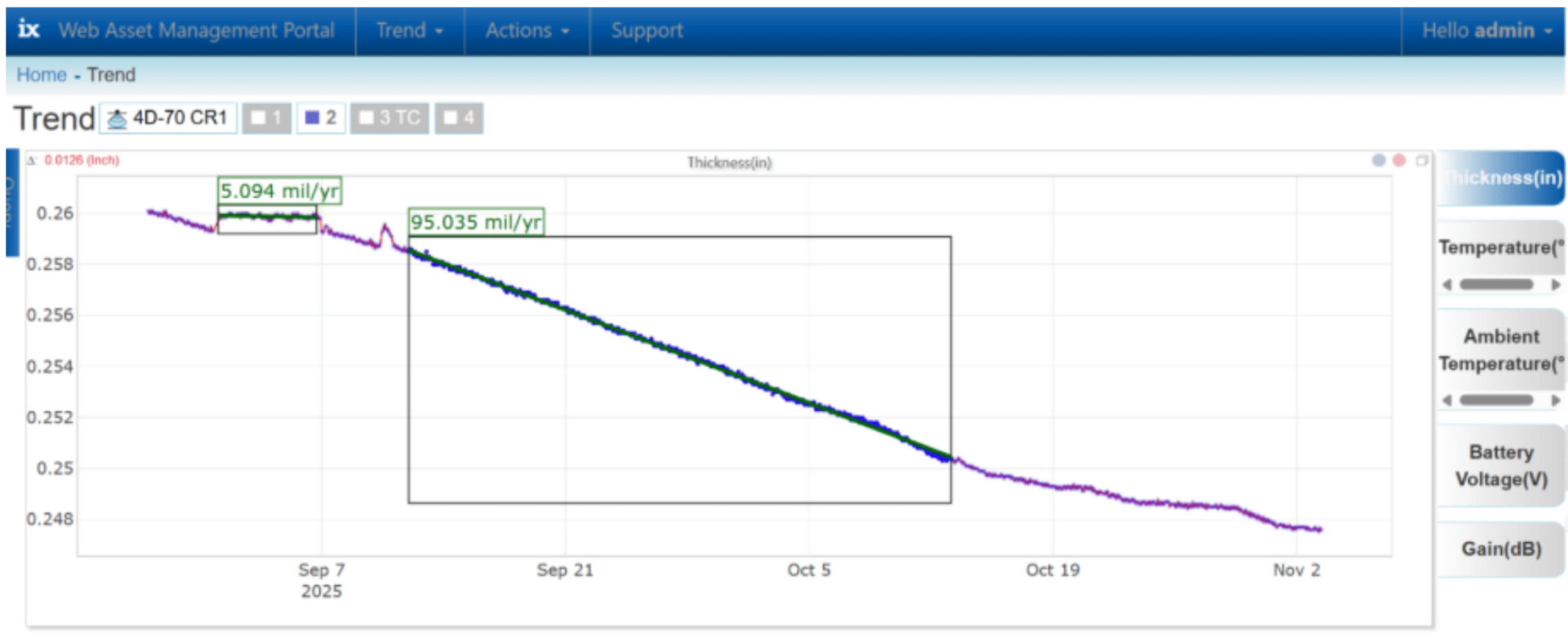
Using HotSense™ installed with CALIPERAY monitoring nodes allowed for automated, robust and reliable wall thickness measurements to be collected from live high temperature assets.