
APPLICATION NOTE | On-Stream Ultrasonic Phased-Array Corrosion Mapping
Highlights:
- Advanced corrosion mapping using Ultrasonic Phased Array (PAUT0 and HotSense HeatMaster solutions.
- Continuous and reliable inspection of high-temperature assets while in operation.
- Enhanced safety and efficiency with minimal downtime.
The Challenge:
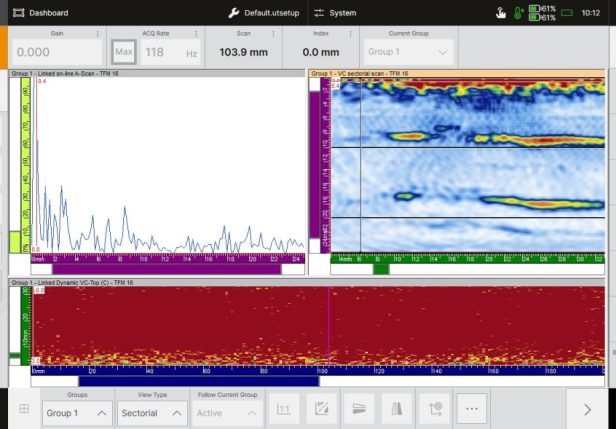
Ultrasonic Testing (UT) for wall thickness measurement is a cornerstone of Non-Destructive Testing (NDT), frequently employed to asses corrosion damage across various industries. Traditionally, this has involved conventional UT methods, such as spot readings with dual element transducers or C-scan mapping via encoded raster arms. The adoption of Ultrasonic Phased Array (PAUT) has further improved efficiency by increasing aperture, covering larger areas per scan and providing greater detection probability for complex flaw and detailed damage morphology, especially when advanced data techniques like Total Focussing Method (TFM) are used).
These inspections are commonplace in sectors ranging from Aerospace and Civil Engineering to critical infrastructure in Energy, where power generation and the extraction and refining of oil and gas equipment operates at elevated temperatures above 80 °C (176 °F). Such environments exceed the limits of standard PAUT transducers and their coupling wedges, which are typically constructed using composite materials sensitive to thermal expansion and degradation.
Historically, high-temperature assets have been inspected during planned shutdowns, incurring costly production losses and potentially aggravating corrosion due to heat cycling.
Development of on-stream procedures and processes, and deployment of modern UT equipment, and such as the Ionix HotSense UT range, now allow for accurate and repeatable wall thickness measurements at continuous temperatures up to
350 °C ( 662 °F), compatible with commercial pumpable couplants and automated high-temperature scanners from leading providers enabling operators to undertake on-stream inspections safely, accurately and reliably.
High-temperature assets are subject to a range of corrosion damage mechanisms. The most prevalent corrosion mechanism downstream is sulfidation where sulphur in hydrocarbons react with iron >260 °C, and more broadly flow-assisted corrosion is found across energy assets.
However, PAUT remains fundamentally limited for high-temperature service due to its reliance on composite transducer construction.
Conventional workarounds, such as duty cycling probes or deploying and discarding multiple transducers, either negate the advantages of PAUT or become prohibitively expensive and time-consuming. Thus, solving the challenge of high-temperature PAUT (HT-PAUT) is essential to unlock the full benefits of on-stream corrosion inspection.
The Solution:
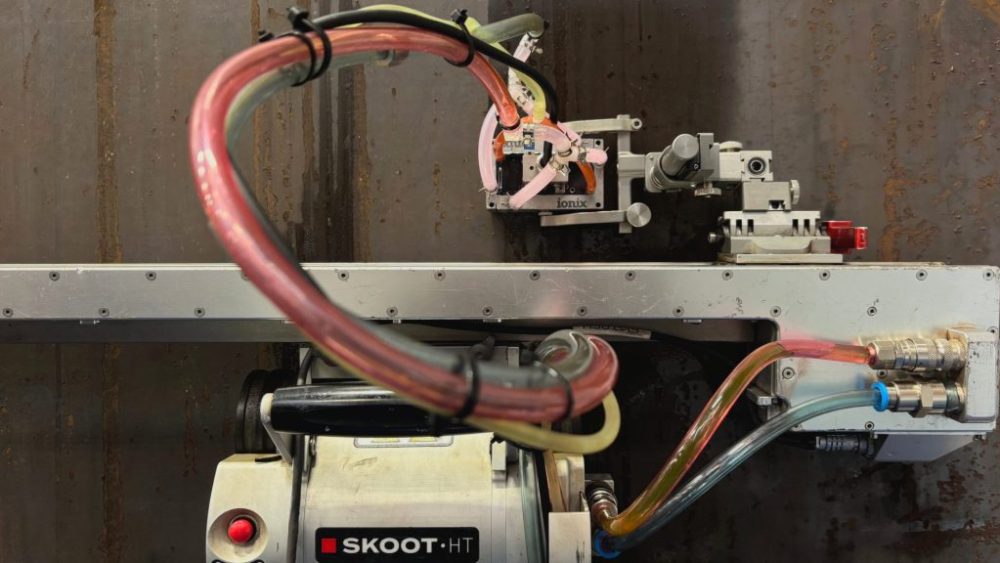
Ionix presents a new solution for HT-PAUT: the HotSense™ HeatMaster actively cooled wedge.
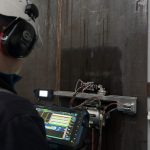
The HeatMaster system enables inspectors to use their existing PAUT transducers by integrating them onto a compact, actively cooled 0-degree wedge. This solution supports continuous inspection from 55 °C up to over 250 °C, making on-stream PAUT more accessible and cost-effective. The wedge combines an engineering polymer with a metal cooling frame, compatible with high-temperature scanner cooling systems or standalone chillers, maintaining the transducer array below 75 °C (note: maximum operating temperature is transducer manufacturer dependent).
The Benefits:
- Enables on-stream corrosion inspection without shutdowns, reducing downtime and production losses.
- Supports safe, remote operation for inspectors, minimising exposure to hazardous conditions.
- Delivers accurate, repeatable wall thickness measurements across a wide range of temperatures.
- Flexible, cost-effective solution adaptable to various asset types and geometries.
- Facilitates real-time fitness for service assessments, aiding asset reliability and lifecycle management.