
CASE STUDY | High-temperature UT Inspection of Coarse-Grained Stainless Steel Using HotSense™ UT.
In-service, UT to ensure reliable thickness data on Inservice, UT to ensure reliable thickness data on coarse-grained stainless steel
Key Deliverables
- Correct probe selection restored reliable UT performance.
- Lower frequency HotSense™ 2.5 MHz probe successfully overcame coarse-grain attenuation and high-temperature acoustic losses.
- Enabled safe, accurate, in-service thickness measurement on austenitic stainless steel up to 360 °C.
- Delivered strong signal stability, allowing engineering teams to confidently use the data for integrity assessment.
Overview
A high-temperature ultrasonic thickness measurement inspection was required on an in-service vessel constructed from SA240 TP321 coarse-grained austenitic stainless steel, operating at temperatures between 270 °C and 360 °C. Initial attempts using a 5 MHz probe provided too much scattering as the wavelength at high-temperatures (lower velocity) presenting a low amplitude backwall response. A technical evaluation determined that a lower frequency 2.5 MHz, larger diameter HotSense™ transducer would be better suited to overcome signal attenuation in coarse-grain structures. The replacement probe was deployed successfully, achieving clear, consistent readings.
The Challenge
The inspection team faced several technical barriers:
- Severe attenuation by scattering from SA240 TP321’s coarse austenitic grain structure caused loss of backwall echo at 5 MHz, producing insufficient signal-to-noise ratio (SNR).
- Elevated temperature conditions (270–360 °C) further increased material damping and reduced wavelength, increasing scattering and attenuation.
- A reliable in-service inspection was required without shutdown, meaning the transducer needed to perform at full operating temperature using high temperature couplants and established procedures.
- Industry compliance was mandatory, requiring work to follow ASME V, Article 4 and ASTM E797.
The Solution
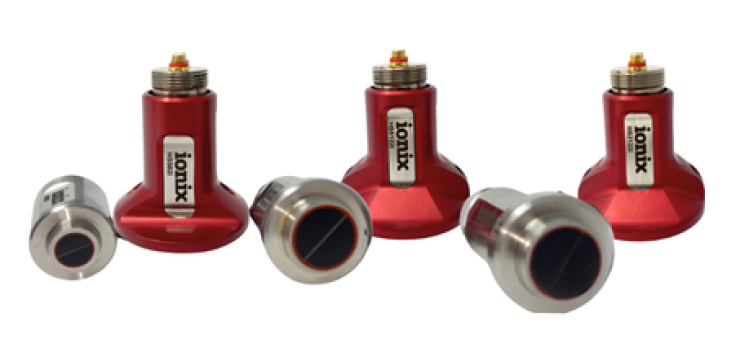
A technical justification concluded that switching from a 5 MHz to a 2.5 MHz HS2122i HotSense™ high-temperature probe would significantly improve penetration and echo stability.
Key factors behind the successful selection:
- Lower frequency (2.5 MHz) produced a longer wavelength, reducing grain scattering and restoring a stable backwall echo.
- High-temperature rating of the Ionix transducer allowed safe, continuous use up to 350 °.
- Compatibility with existing equipment allowed immediate deployment with no additional training.
The Execution
The inspection team followed standard high-temperature UT guidelines
Key factors behind the successful selection:
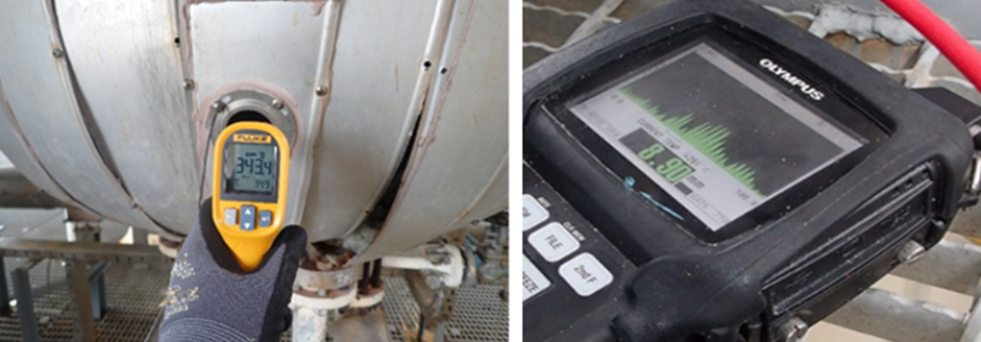
- Pre-calibration of the ultrasonic thickness gauge at ambient temperature per ASME V & ASTM E797.
- Enabling temperature compensation for operation up to 360 °C.
- Deployment of Ionix HotSense™ 2.5 MHz transducer with high temperature couplant.
- Performing ultrasonic thickness readings using echo to echo technique, allowing measurement through existing coating.
- Multiple readings (minimum three) were taken per location to confirm repeatability.
- Post calibration verified measurement stability after the probe cooled.